
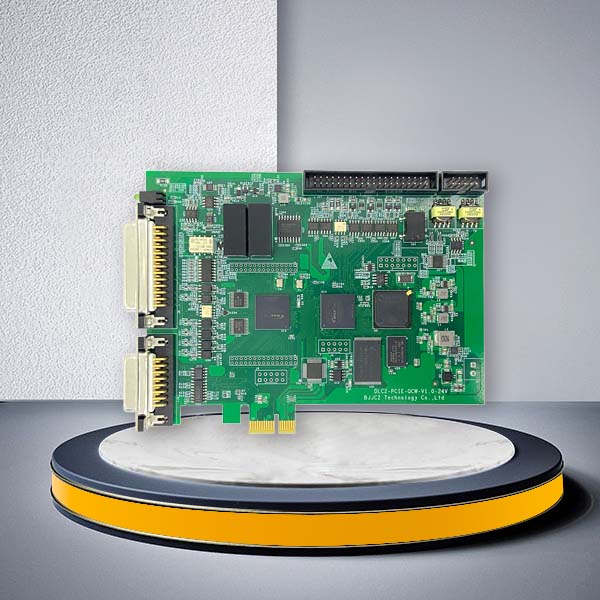
| Configurations | |
| Connection Method | PCIE Card Slot |
| Operating System | WIN7/WIN10/WIN11, 64-bit Systems |
| Galvo Scanner Control Protocol | All Mainstream Mirror Types In The Market |
| Encoder Input | 2 Channels |
| Number of Input Ports | 10 Channels |
| Number of Output Ports | 8 Channels |
| Compatible Lasers | IPG-YLM Series (5V) |
| Power Waveform Output | Supported |
| Laser Safety Protection | Supported |
| Configurations | |
| Connection Method | PCIE Card Slot |
| Operating System | WIN7/WIN10/WIN11, 64-bit Systems |
| Galvo Scanner Control Protocol | All Mainstream Mirror Types In The Market |
| Encoder Input | 2 Channels |
| Waveform Output | Supported |
| Analog Signal Acquisition | 4 Channels |
| Number of Input Ports | 10 Channels |
| Number of Output Ports | 8 Channels |
| Compatible Lasers | IPG-YLM Series (24V) |
| Dual-beam Power Control | Supported |
| Laser Safety Protection | Supported |
| Analog Signal Input | 2 Channels |
| Equipped with a watchdog function to prevent abnormal prolonged laser emissions | |
DLC2PCIE – QCW Laser Welding Controller
The DLC2PCIE-QCW is a high-power laser welding control card designed for industrial galvo laser welding systems. Featuring a PCIe interface, it integrates laser control, galvo scanner communication, encoder feedback, and digital I/O functions to support precise control and equipment integration.
Available in DLC2PCIE-QCW-5V and DLC2PCIE-QCW-24V configurations, this QCW laser welding controller is designed for compatible IPG-YLM series laser sources. Both versions support power waveform output, while the 24V version additionally provides dual-beam power control and analog signal interfaces for center-beam and ring-beam laser configurations.
With its hardware control capabilities and compatibility with JCZ laser welding software, the DLC2PCIE-QCW provides a control platform for laser welding machine manufacturers, industrial equipment manufacturers, and laser system integrators.
Why Choose DLC2PCIE-QCW Laser Welding Controller?
For laser welding equipment manufacturers, selecting a controller involves more than checking its communication interface. The controller must coordinate the laser source, galvo scanner, external signals, and processing requirements within the equipment architecture.
The DLC2PCIE-QCW combines several control functions on one PCIe-based hardware platform.
- PCIe Hardware Connection: Connects directly to an industrial computer through a PCIe card slot.
- 5V and 24V Laser Configurations: Provides two versions for different laser control interface requirements.
- Galvo Scanner Control: Supports mainstream galvo scanner control protocols.
- Laser Power Waveform Output: Supports waveform-based laser power control.
- Encoder Feedback: Provides two encoder input channels for external signal integration.
- Digital I/O: Includes 10 input channels and 8 output channels for equipment control and signal interaction.
- Dual-Beam Power Control: The 24V version supports independent or simultaneous center-beam and ring-beam power adjustment.
- Safety Protection: Includes laser safety protection, with an additional watchdog function specified for the 24V version.

DLC2PCIE-QCW-5V and DLC2PCIE-QCW-24V Configurations
The DLC2PCIE QCW laser welding control card is available in two configurations to accommodate different laser source control interfaces and welding system requirements.
The main selection factor is the laser control voltage. The 5V version is designed for compatible 5V IPG-YLM laser sources, while the 24V version is designed for compatible 24V IPG-YLM laser sources and provides additional dual-beam and analog signal functions.
DLC2PCIE-QCW-5V
The DLC2PCIE-QCW-5V is designed for compatible IPG-YLM series laser sources with 5V control signals. It provides laser control, galvo scanner communication, encoder input, digital I/O, and power waveform output.
This configuration is suitable for equipment manufacturers who need standard QCW laser welding control without the additional dual-beam power control functions of the 24V version.
DLC2PCIE-QCW-24V
The DLC2PCIE-QCW-24V is designed for compatible IPG-YLM series laser sources with 24V control signals. In addition to the standard welding control functions, it supports dual-beam power control, four analog signal acquisition channels, and two analog signal input channels.
Its dual-beam function allows the center-beam and ring-beam power to be controlled simultaneously or independently. Users can also adjust the power according to the position along the processing trajectory.
5V vs. 24V Laser Welding Controller Comparison
| Specifications | DLC2PCIE-QCW-5V | DLC2PCIE-QCW-24V |
|---|---|---|
| Hardware Interface | PCIe Card Slot | PCIe Card Slot |
| Operating System | Windows 7/10/11 (64-bit) | Windows 7/10/11 (64-bit) |
| Compatible Laser | IPG-YLM Series (5V) | IPG-YLM Series (24V) |
| Galvo Scanner Protocol | Mainstream Galvo Protocols | Mainstream Galvo Protocols |
| Encoder Input | 2 Channels | 2 Channels |
| Digital Input | 10 Channels | 10 Channels |
| Digital Output | 8 Channels | 8 Channels |
| Power Waveform Output | Supported | Supported |
| Analog Signal Acquisition | Not Specified | 4 Channels |
| Analog Signal Input | Not Specified | 2 Channels |
| Dual-Beam Power Control | Not Supported | Supported |
| Laser Safety Protection | Supported | Supported |
| Watchdog Function | Not Specified | Supported |
How to choose: Select the 5V version for a compatible 5V laser interface and standard QCW welding control requirements. Select the 24V version when the laser system uses a compatible 24V interface and requires dual-beam power control or additional analog signal functions.
Laser Power Waveform Control for Welding Applications
Laser power waveform control is an important function in laser welding systems, particularly when different stages of a welding path require different laser energy levels.
The DLC2PCIE-QCW supports power waveform output, providing a hardware foundation for controlling laser power according to configured processing requirements.
When paired with compatible Laser Welding Studio software, users can configure time-based laser power curves and define gradual power changes during the welding process.
Start and End Power Adjustment
During welding, the required laser power may differ between the beginning, middle, and end of a processing path. Gradual power adjustment can be configured through the welding software to manage energy transitions along the trajectory.
Time-Based Power Curve Editing
Laser Welding Studio provides power curve editing for applications that require more detailed control of laser energy over time. This helps equipment developers configure welding processes according to different workpiece geometries and process conditions.
Processing Trajectory-Related Power Control
For the DLC2PCIE-QCW-24V dual-beam configuration, laser power can be adjusted according to the position along the processing trajectory. This allows the center and ring beams to follow different power settings where required.
Dual-Beam Laser Welding Control: Center Beam and Ring Beam
Dual-beam laser welding uses a center beam and a surrounding ring beam to distribute laser energy across the processing area. The power relationship between the two beams can affect the welding process and must be configured according to the laser source and application requirements.
The DLC2PCIE-QCW-24V supports dual-beam power control for compatible laser systems. The center beam and ring beam can be controlled simultaneously or separately, providing additional flexibility in laser energy adjustment.
Independent Center-Beam and Ring-Beam Control
The controller supports separate power adjustment for the center beam and ring beam. This allows users to configure different power levels for the two laser outputs according to the welding process.
Simultaneous Dual-Beam Control
Both beams can also be controlled simultaneously. This is useful for welding systems that require coordinated center-beam and ring-beam operation.
Trajectory-Based Power Adjustment
The 24V configuration supports changing laser power according to the position along the processing path. When configured with the appropriate software and laser source, this function provides greater flexibility for complex welding trajectories.
For equipment manufacturers developing dual-beam laser welding machines, the 24V version should be evaluated based on the laser source’s analog control interface, signal requirements, and software configuration.
Hardware Interfaces and Control Capabilities
A laser welding controller must communicate with multiple components in an industrial laser processing system. These may include the laser source, galvo scanner, encoder, and external equipment control signals.
The DLC2PCIE-QCW integrates several hardware interfaces to support these connections.
PCIe Connection for Industrial Computers
The DLC2PCIE-QCW uses a PCIe card slot as its hardware connection method. It can be installed in a compatible industrial computer to provide the control interface for the laser welding system.
Before installation, equipment developers should verify that the computer motherboard provides a compatible PCIe slot and meets the operating system requirements.
Galvo Scanner Control Interface
The controller supports mainstream galvo scanner control protocols. It can be used in galvo-based laser welding systems where the scanner directs the laser beam along programmed processing trajectories.
Because different scanner manufacturers and models may use different communication requirements, the exact scanner protocol should be confirmed before purchasing the control card.
Digital Input and Output
The DLC2PCIE-QCW provides 10 digital input channels and 8 digital output channels.
These channels provide signal connections for external equipment and control logic. Depending on the equipment architecture, digital I/O can be used for process triggering, signal interaction, and coordination with other automation components.
Encoder Feedback
Two encoder input channels are provided for external encoder signal integration. Encoder feedback can be relevant in automated laser welding equipment where movement or position information needs to be incorporated into the control system.
The encoder type, electrical signal specifications, and connection method should be checked against the actual equipment requirements.
Analog Signal Acquisition and Input
The DLC2PCIE-QCW-24V provides four analog signal acquisition channels and two analog signal input channels.
These additional channels are particularly relevant when integrating a dual-beam laser system or other external analog signal requirements. The supported signal range and electrical specifications should be confirmed with JCZ before system design.
Laser Safety Protection and Watchdog
Laser safety protection is included in both published controller configurations. The 24V version additionally specifies a watchdog function designed to prevent abnormal prolonged laser emission.
When designing an industrial laser welding machine, the controller should be integrated with the complete machine’s safety interlocks, emergency stop circuits, and laser source protection requirements. The controller’s safety functions do not replace the machine-level safety design.
Laser Welding Software and Control System Integration
The DLC2PCIE-QCW is a hardware component of a laser welding control system. When paired with JCZ Laser Welding Studio, the hardware and software work together to support graphical welding task design, laser power configuration, and equipment integration.
For laser equipment manufacturers, the software provides tools for creating processing tasks and coordinating the laser and galvo scanner according to the required welding process.
Graphic Processing and CAD Import
Laser Welding Studio supports drawing points, lines, arcs, spirals, rectangles, and arbitrary curves. It also supports DXF file import, allowing users to prepare welding graphics based on engineering drawings.
Welding Position Teaching and Vision Integration
The software supports teaching functions that allow users to adjust galvo positions through mouse operations. With coaxial vision integration, welding positions can be determined using visual positioning information.
For applications requiring more flexible positioning, the welding system can be configured with machine vision components according to the equipment design.
Multiple Graphic Files and Process Logic
Laser Welding Studio supports multiple graphic files and different triggering methods for combined processing tasks. This allows equipment developers to configure processing sequences and logic according to production requirements.
Jitter Control for Welding Trajectories
The software supports several jitter trajectory patterns, including sine, spiral, figure-eight, and inverted figure-eight patterns. Trajectory density and speed can be adjusted to suit different welding process configurations.
Laser Power Curve Editing
Power curve editing allows users to configure laser power changes over time. Start and end power transitions can also be adjusted through linear power transformation functions.
Motion Control and Automation Integration
The complete JCZ welding system can be expanded with motion control hardware to support up to four-axis stepper or servo motor control, depending on the selected configuration.
For customized equipment, interfaces with third-party machine vision systems, PLCs, motion controllers, and production management databases can also be developed according to project requirements.
For more information about JCZ laser control and welding system solutions, visit the Laser Control Systems page.
Applications of QCW Laser Welding Controller
The DLC2PCIE-QCW is intended for integration into industrial laser welding equipment. Its laser control, galvo scanner communication, encoder input, and I/O capabilities make it suitable for system designs that require coordinated laser and motion-related control.
Battery Manufacturing Equipment
Laser welding systems are used in battery manufacturing for different components and assembly processes. Applications may include battery tabs, busbars, explosion-proof valve components, and battery housing-related welding.
When integrated with compatible laser sources, vision components, and automation equipment, the DLC2PCIE-QCW can serve as the hardware control component of a galvo welding system.
Automotive Component Welding
Automotive manufacturing involves laser welding of metal components and precision assemblies. Galvo-based laser welding systems can be configured for programmed welding paths and automated production processes.
The controller’s digital I/O and encoder interfaces provide connection options for equipment integration according to the machine design.
Precision Metal Welding
Precision metal welding often requires controlled laser power and accurately defined processing trajectories. The DLC2PCIE-QCW supports power waveform output and galvo scanner control for compatible laser welding configurations.
Electronic Component Welding
Electronic and electrical component manufacturing may involve small metal parts, conductive components, and precision assemblies. With appropriate laser sources, optics, and process parameters, galvo welding systems can be configured for these applications.
Automated Laser Welding Production Lines
For automated production equipment, the controller’s encoder inputs and digital I/O provide hardware interfaces for coordination with external equipment. Additional machine vision and motion control components can be integrated into a complete welding system according to project requirements.
How to Select a Laser Welding Control Card
Selecting the right laser welding controller requires checking the compatibility of the laser source, galvo scanner, computer, and external equipment. A control card that has the correct communication interface may still require additional compatibility verification before installation.
1. Confirm the Laser Source Model
Start by identifying the laser source manufacturer and exact model. Check its control interface, voltage requirements, signal definitions, and supported control functions.
The published DLC2PCIE-QCW configurations specify IPG-YLM series laser sources with 5V and 24V control interfaces. Other laser brands or models should be evaluated individually.
2. Check the Control Voltage
The control voltage is one of the main factors when selecting between the two DLC2PCIE-QCW configurations.
- 5V control interface: Evaluate the DLC2PCIE-QCW-5V.
- 24V control interface: Evaluate the DLC2PCIE-QCW-24V.
Do not select the controller based only on the voltage of the machine’s general power supply. The laser source’s actual control signal requirements must be checked.
3. Verify Galvo Scanner Compatibility
Check the scanner manufacturer, model, and communication protocol. The controller supports mainstream galvo scanner protocols, but the exact compatibility should be verified before ordering.
4. Determine Whether Dual-Beam Control Is Required
If the welding system uses a center-beam and ring-beam laser configuration, confirm whether independent or simultaneous power adjustment is required. The DLC2PCIE-QCW-24V supports dual-beam power control.
5. Evaluate I/O and Analog Signal Requirements
Calculate the number of digital input and output channels required by the equipment. If the system requires analog signal acquisition or analog input, evaluate the additional channels available on the 24V configuration.
6. Confirm Computer and Software Compatibility
The controller specifies Windows 7, Windows 10, and Windows 11 64-bit operating system support. The industrial computer should also have a compatible PCIe slot.
Confirm the required software, driver, licensing, and hardware configuration before integrating the controller into the production machine.
Frequently Asked Questions About DLC2PCIE-QCW
1. What is a QCW laser welding controller?
A QCW laser welding controller is a hardware control component used in laser welding equipment to coordinate laser source signals and related processing components. The DLC2PCIE-QCW is a PCIe-based control card designed for compatible high-power laser welding systems.
2. What does DLC2PCIE-QCW stand for?
DLC2PCIE-QCW refers to JCZ’s DLC2PCIE QCW laser welding control card series. It is designed for QCW laser welding control and is available in 5V and 24V configurations.
3. Is DLC2PCIE-QCW compatible with continuous-wave and QCW lasers?
The QCW interface family is designed for compatible CW or QCW laser sources using the corresponding 5V or 24V control signals. For the DLC2PCIE-QCW configurations listed on this page, IPG-YLM series compatibility is specified. Confirm the exact laser model and interface before purchasing.
4. What is the difference between the 5V and 24V versions?
The two versions are designed for different laser control voltage requirements. The 24V version additionally supports dual-beam power control, four analog signal acquisition channels, and two analog signal input channels. Both versions support two encoder inputs, ten digital inputs, eight digital outputs, and power waveform output.
5. Does the controller support dual-beam laser welding?
Yes. The DLC2PCIE-QCW-24V supports center-beam and ring-beam power control. Both beams can be adjusted independently or simultaneously, and laser power can be changed according to the processing trajectory.
6. Can the DLC2PCIE-QCW control a galvo scanner?
Yes. The controller supports mainstream galvo scanner control protocols. However, the specific scanner model and communication protocol should be confirmed to ensure compatibility.
7. How many digital I/O channels are available?
Both versions provide 10 digital input channels and 8 digital output channels. These interfaces can be used for external equipment signal interaction and process control according to the system configuration.
8. Does the controller support encoder feedback?
Yes. The DLC2PCIE-QCW provides two encoder input channels for integration with external encoder signals. The electrical signal specifications and encoder compatibility should be confirmed before installation.
9. What software works with the DLC2PCIE-QCW?
The DLC2PCIE-QCW can be used as the hardware component of a JCZ laser welding control system with Laser Welding Studio. The software provides graphical processing design, CAD import, welding trajectory configuration, laser power curve editing, and system integration functions. Confirm the compatible software version and licensing configuration with JCZ.
10. What computer configuration is required?
The published product specifications list Windows 7, Windows 10, and Windows 11 64-bit operating systems. The computer must also provide a compatible PCIe card slot. Additional computer requirements should be checked against the selected software version.
11. Can the DLC2PCIE-QCW be integrated into an automated welding machine?
Yes. Its encoder inputs and digital I/O provide hardware interfaces for integration into compatible automated laser welding equipment. Additional motion control, PLC, and machine vision functions may be configured through the complete welding system according to project requirements.
12. How can I confirm whether the controller is compatible with my laser source?
Provide the laser source manufacturer, exact model, control voltage, interface specifications, and required control signals. JCZ can use this information to evaluate whether the DLC2PCIE-QCW-5V or DLC2PCIE-QCW-24V is suitable for your system.
Get Technical Support for DLC2PCIE-QCW Laser Welding Controller
Choosing a suitable laser welding control card requires matching the controller with the laser source, galvo scanner, and equipment architecture.
JCZ provides DLC2PCIE-QCW-5V and DLC2PCIE-QCW-24V configurations for different QCW laser welding control requirements. Whether you are developing a new laser welding machine or upgrading an existing system, our team can help evaluate the appropriate hardware configuration.
Contact JCZ to discuss your laser welding control requirements and confirm the compatibility of the DLC2PCIE-QCW series with your equipment.


