| Parameter | ||
| Product Model | Lark-355-3A | Lark-355-5A |
| Central Emission Wavelength | 355nm | |
| Average Power | >3W@40kHz | >5W@40kHz |
| Pulse Duration | <18ns@40kHz | |
| Pulse Repetition Rate Range | 20kHz-200kHz | |
| Spatial Mode | TEM00 | |
| Beam Quality | M² ≤ 1.2 | |
| Beam circularity | >90% | |
| Beam Full Divergence Angle | <2mrad | |
| Beam Diameter | Mon-expanding:0.45±0.15mm | Mon-expanding:0.5±0.15mm |
| Polarization Ratio | > 100:1 | |
| Polarization Orientation | Horizontal | |
| Average Power Stability | RMS ≤ 3% @ 24hrs | RMS ≤ 5% @ 24hrs |
| Pulse to Pulse Energy Stability | RMS ≤ 3% @ 40kHz | RMS ≤ 3% @ 50kHz |
| Operating Temperature | 0~40℃ | |
| Storage Temperature | -15~50℃ | |
| Cooling Method | Air-cooling | |
| Supply Voltage | DC 12V | |
| Average Power Consumption | <180W | <200W |
| Three- Dimensions (WXDXH) | 313 × 144× 126mm | 348 × 144× 126mm |
| Weight | 6.8kg | |
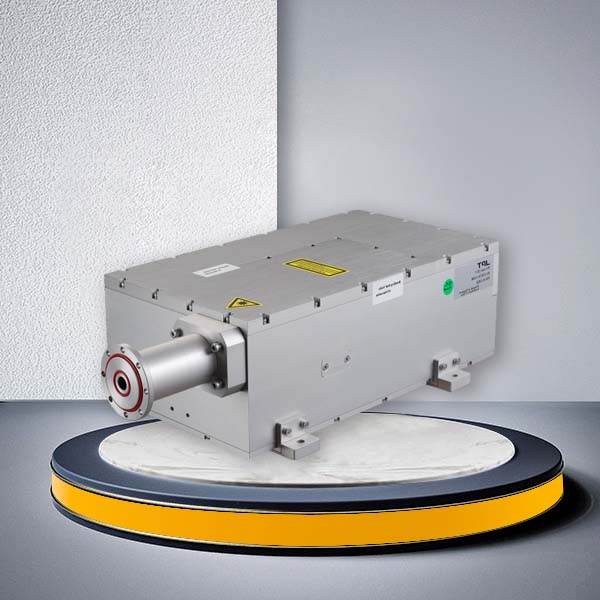
JPT LARK 355nm Air-Cooled UV Laser Source
Lark-355 is the ultraviolet product of lark series at present. It adopts the heat management mode of conduction heat dissipation combined with air convection heat dissipation. Compared with Seal-355-3S, the water circulation cooling system is omitted, and customers can choose multiple lasers of the same level according to the actual situation. Compared with other similar products, in terms of optical parameters, it achieves narrower pulse width. In terms of structural design, smaller size, lighter weight and better appearance; in terms of electrical control design, Strong anti-electromagnetic interference ability, high thermal management efficiency, friendly GUI interactive interface. These characteristics make the product have better structural stability and stronger environmental adaptability, and thus realize the characteristics of good beam quality, high power stability, long life, high consistency, convenient installation, maintenance-free operation and so on.
JPT LARK 3W vs 5W UV Laser Source
| Model | Wavelength | Output Power | Frequency | Cooling | Recommended Direction |
|---|---|---|---|---|---|
| Lark-355-3A | 355nm | >3W @ 40kHz | 20–200kHz | Air-cooled | Fine marking and lower-throughput precision UV processing |
| Lark-355-5A | 355nm | >5W @ 50kHz | 20–200kHz | Air-cooled | Higher-throughput marking, cutting and precision processing |
Both versions use an air-cooled architecture, TEM00 spatial mode and M² ≤1.2 beam quality.
Choose 3W When
The 3W UV laser source is a practical starting point when your machine focuses on:
- Fine plastic marking
- Product identification
- Small QR or Data Matrix codes
- Precision surface processing
- Applications where maximum throughput is not the first priority
Choose 5W When
The 5W UV laser source should be evaluated when you need greater processing capacity for:
- Faster industrial marking
- Cover-film processing
- Glass marking
- Thin-film processing
- Higher-volume production equipment
Do not select power from wattage alone. Material, feature size, required result and cycle time should be tested before the final machine configuration is fixed.
Why Choose an Air-Cooled UV Laser?
The main difference between the JPT LARK and many conventional UV DPSS laser sources is the cooling architecture.
The LARK uses conduction heat dissipation together with air convection rather than requiring a dedicated water-circulation system. JPT positions the series around compact integration, efficient thermal management and easier installation.
For a laser machine manufacturer, eliminating the water chiller can simplify several parts of equipment design.
Simpler Machine Architecture
An air-cooled system can remove the need for:
- External UV laser chiller
- Cooling-water tubing
- Pump and water circuit
- Coolant monitoring
- Chiller installation space
This can be useful when you are developing a compact tabletop, desktop or integrated UV laser machine.
Easier Installation
With fewer cooling components, electrical and mechanical integration can be more straightforward.
The current LARK platform operates from 12V DC and is specifically designed around an air-cooled thermal-management structure.
Lower Cooling-System Maintenance
Removing the water loop also removes maintenance tasks associated with coolant condition, piping and circulation equipment.
JPT specifically positions LARK around easy installation and maintenance-free operation of the laser unit.
LARK Air-Cooled vs SEAL Water-Cooled UV Laser
JCZ also supplies the JPT SEAL 355nm water-cooled UV laser.
Both product families operate at 355nm, but they serve different equipment-design priorities.
| Requirement | JPT LARK | JPT SEAL |
|---|---|---|
| Cooling | Air-cooled | Water-cooled |
| Separate chiller | Not required for laser cooling | Required |
| 3W / 5W options | Yes | Yes |
| Higher-power options | Limited on this LARK page | SEAL family extends to higher powers |
| Machine architecture | Compact, simpler cooling design | Dedicated water-cooled industrial architecture |
| Typical priority | Size, integration simplicity | Thermal control and broader power range |
JPT officially identifies LARK 355-3/5 as air cooled and SEAL 355-3/5 as water cooled.
Choose LARK If
Your machine needs:
- 3W or 5W UV output
- Compact system design
- No dedicated water chiller
- Easier OEM integration
- Reduced cooling-system complexity
Consider SEAL If
Your machine architecture already uses water cooling or you need to evaluate higher-power UV configurations.
The correct choice should be based on the complete equipment architecture rather than assuming that air cooling or water cooling is universally better.
Beam Quality for Precision 355nm Processing
For UV processing, average power is only one part of laser-source selection.
The LARK models currently listed by JCZ provide:
- 355nm wavelength
- TEM00 spatial mode
- M² ≤1.2
- Beam circularity >90%
- Beam divergence <2 mrad
- Horizontal polarization
- Polarization ratio >100:1
- 20–200 kHz repetition-rate range
These parameters matter when the finished machine needs to produce small characters, fine codes, narrow cuts or repeatable precision features.
When comparing 355nm UV laser sources, evaluate beam quality, pulse behavior, power stability and optical compatibility together rather than comparing wattage alone.

Applications for the JPT LARK 355nm UV Laser
JPT currently lists several applications for the LARK 355 series, including mobile-phone-case marking, cover-film cutting, glass marking, thin-film drilling, SLA photocuring and plastic marking.
Plastic Marking
A 355nm UV laser source is frequently selected for plastics where conventional infrared processing produces excessive thermal effects or poor contrast.
Possible equipment applications include:
- Electronic housings
- Connectors
- Plastic components
- Consumer-electronics parts
- Product traceability
- Fine QR and Data Matrix marking
Polymer formulations vary significantly, so sample testing should be completed before a machine design is standardized.
Glass Marking
JPT also lists glass marking as a LARK application.
When designing a UV laser machine for glass, provide:
- Glass type
- Thickness
- Required mark
- Processing depth
- Surface or internal processing requirement
- Target cycle time
These factors are more useful for laser selection than simply requesting a “5W UV laser.”
Cover Film Cutting
The short 355nm wavelength can also be used in precision thin-film processing.
JPT specifically lists cover film cutting among LARK applications.
For OEM cutting equipment, the machine manufacturer should provide film type, thickness, required kerf width and production speed before selecting the source and optical system.
Thin Film Drilling
Thin-film drilling is another official application direction for the LARK 355 platform.
For these projects, processing results depend on much more than laser power. Beam delivery, focusing optics, positioning accuracy and motion strategy should be designed together.
SLA Photocuring
JPT also lists SLA photocuring among LARK 355 applications, making the source relevant beyond conventional marking-machine development.
Why Air Cooling Matters for Compact OEM UV Machines
For equipment manufacturers, the strongest commercial advantage of the LARK is not simply that it has a fan instead of a water chiller.
It allows you to reconsider the complete machine architecture.
Eliminating a dedicated water-cooling circuit can potentially simplify:
- Equipment footprint
- Cabinet layout
- Shipping configuration
- Installation procedure
- Field maintenance
- Service documentation
This is particularly relevant when your product strategy focuses on compact UV marking equipment rather than a larger industrial station with an existing centralized cooling system.
LARK 355 for OEM Laser Machine Development
When you design a UV laser machine for resale, you also need to consider what happens after the equipment leaves your factory.
Your laser-source decision affects:
- Machine dimensions
- Electrical design
- Cooling layout
- Spare-parts strategy
- Installation requirements
- Technician training
- After-sales troubleshooting
For a 3W or 5W platform, an air-cooled UV laser source can make the machine easier to standardize when compact installation and reduced cooling complexity are important design targets.
Frequently Asked Questions
Is the JPT LARK a 355nm UV laser source?
Yes. The current LARK 355-3/5 platform operates at 355nm and is categorized by JPT as a DPSS laser series.
Is the JPT LARK air cooled?
Yes. The LARK models covered on this page use air cooling rather than a water-circulation cooling system.
Does the LARK need a water chiller?
The laser itself uses an air-cooled thermal-management structure, so it does not require the dedicated water-cooling circuit used by the SEAL water-cooled series.
Should I choose 3W or 5W?
Choose according to the material, feature size, process and required cycle time. 5W provides greater processing capacity, but higher wattage is not automatically necessary for every precision-marking application.
What is the frequency range?
The Lark-355-3A and Lark-355-5A currently list a 20–200 kHz repetition-rate range.
Is LARK suitable for plastic marking?
Yes. JPT lists plastic marking as one of the application directions for the LARK 355 series. Actual results still depend on the specific polymer formulation and should be verified with sample testing.
What is the difference between LARK and SEAL?
The most direct difference at the 3W/5W level is cooling architecture: LARK is air cooled, while SEAL is water cooled. The final choice should also consider machine size, environmental conditions and overall equipment architecture.
Configure a 355nm Air-Cooled UV Laser for Your Machine
The right 355nm air-cooled UV laser source should be selected around the machine you intend to manufacture.
If you are developing a compact UV marking, cutting or precision-processing system, send JCZ your material, required process, cycle time, optical field and equipment architecture.
We can help you evaluate whether the JPT Lark-355-3A or Lark-355-5A is the appropriate choice and match the source with the required controller, galvo scanner and optical system.
Contact JCZ for technical configuration and quotation.