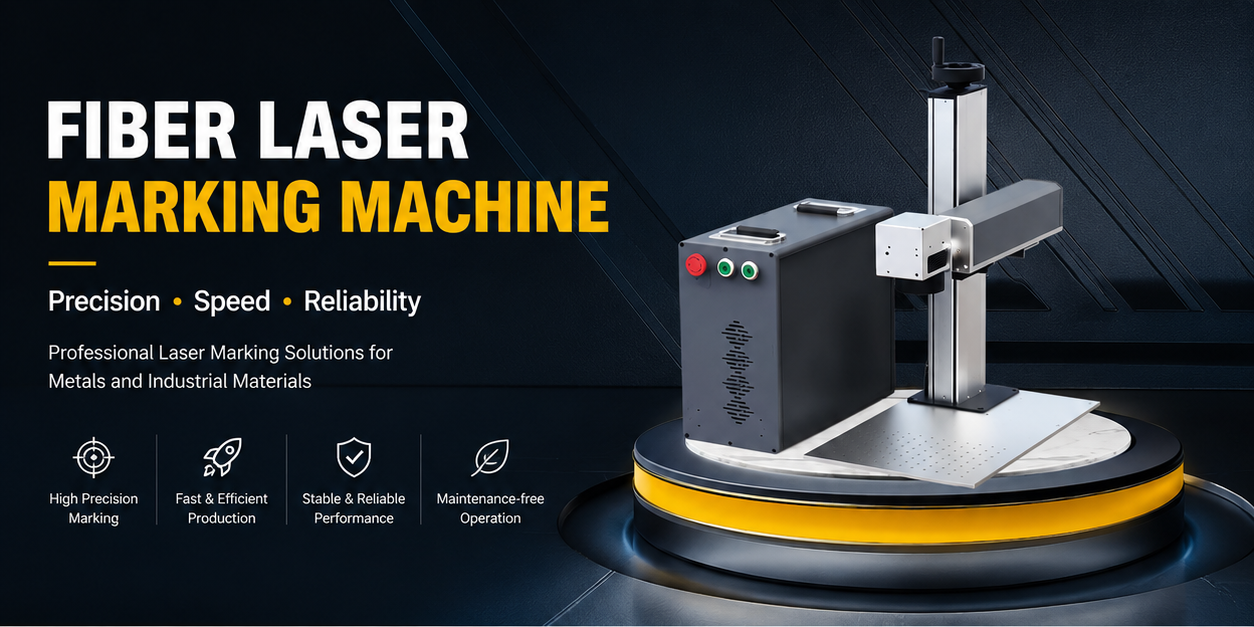
With the development of production technology such as automation and digital manufacturing, the fiber laser marking machine is one of a few best choices for permanent product labeling. The quality of marking in comparison to conventional printing, inkjet and engraving, fiber laser processing can marking with high precision, attarctive, never fade and good cost performance.
Whether you are etching serial numbers, QR codes, logos, bar codes, or just need to add a splash of color to stainless steel, the latest in fiber laser marking technology IDs can be a economical option for manufacturers who span a wide range of industries.
This Guide will explain how fiber laser technology differs from others, the advantages, applications, machine typologies and how to select the best system for your line.
What’s the deal with Fiber Lasers?
A fiber laser is a type of solid-state laser where the active gain medium is an optical fiber doped with a rare-earth element, such as ytterbium, erbium, etc. The laser beam is, instead, transmitted as a carrier wave in an optical fiber, without being reflected and refocused by conventional mirrors, leading to an improved beam quality and stability for high energy throughput.
Stated Fiber lasers are also known to be very good at marking metals and some plastics engineers due to the fact they usually run at a wavelength of 1064 nm wavelength.Just as with CO 2 lasers and UV lasers, fiber lasers have the following characteristics:
- Higher electrical efficiency
- Longer service life
- Excellent beam quality
- Low maintenance requirements
- High-speed marking capability
- Superior reliability for industrial production
What Is Fiber Laser Marking Machine?
A fiber laser marking machine is a laser processing equipment, can make permanent marking on materials by high energy laser beam focusing on material surface.
Without cutting through thick material, the laser alters the surface of the material with oxidation, annealing, engraving or ablation to produce permanent marks. Common marking content includes:
- Company logos
- QR codes
- Data Matrix codes
- Serial numbers
- VIN numbers
- Product identification
- Date codes
- Batch numbers
- Decorative graphics
- Variable data
Because it does not need ink, chemicals or supplies, the fiber laser marking system significantly reduces the cost to operate.
How Does Fiber Laser Marking Work?
The laser source produces a very focused beam that is steered by high-speed galvanometer scanners through an F-theta lens on the workpiece.The surface is altered by the laser energy through:
- Surface oxidation
- Annealing
- Vaporization
- Surface engraving
- Color oxidation (for certain metals)
The P1 is ideal for creating labels with excellent contrast and durability.
Since the beam diameter is very small, the fiber laser can achieve micron level details and can be used for high precision manufacturing.
Key Advantages of Fiber Laser Marking Machines
1. Permanent Marking
Fiber laser marks resist:
- Wear
- Heat
- Chemicals
- Solvents
- UV exposure
- Corrosion
This makes laser marking ideal for product traceability.
2. Extremely High Precision
Modern systems achieve marking resolutions suitable for:
- Medical devices
- Electronic components
- Semiconductor packaging
- Precision tools
- Aerospace parts
Even tiny QR codes remain highly readable.
3. High-Speed Production
Fiber laser marking machines can process thousands of parts per day with minimal downtime.
High-speed galvo scanners significantly improve production efficiency.
4. No Consumables
Unlike inkjet printers, laser systems require no:
- Ink
- Solvents
- Labels
- Printing ribbons
This lowers operating costs while reducing environmental impact.
5. Long Service Life
Industrial fiber laser sources commonly provide operational lifetimes exceeding 100,000 hours, ensuring years of reliable performance with minimal maintenance.
6. Easy Automation
Fiber laser marking systems can integrate with:
- Conveyor production lines
- Vision positioning systems
- Robotic arms
- MES systems
- ERP systems
- Barcode databases
This supports fully automated manufacturing.
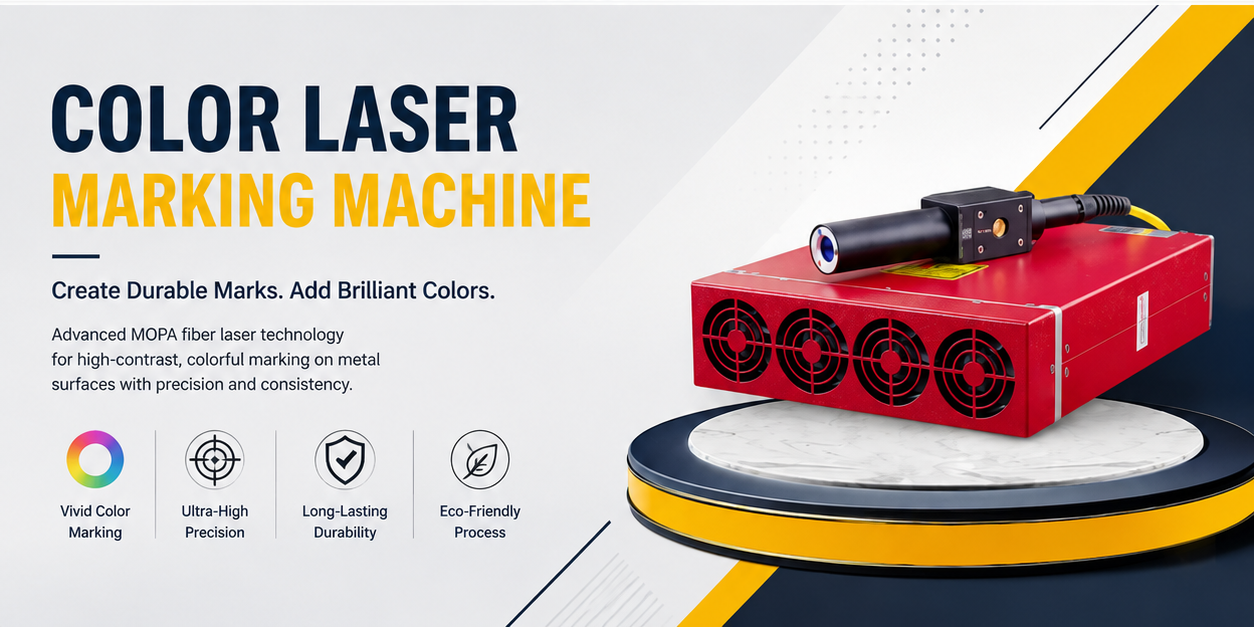
What is the Color Laser Marking Machine?
Color laser marking machine is usually with MOPA fiber laser and it enables the users to fine tune the pulse width and frequency.
Rather than just engraving material, the laser produces controlled oxide layers on stainless steel and titanium that result in vibrant colors, without the use of pigments or dyes or layering.
Possible colors include:
- Blue
- Red
- Green
- Purple
- Gold
- Black
- Cyan
The colors are generated by optical interference, resulting in permanent markings that will not peel or fade.
Benefits of Color Laser Marking
Color laser marking offers several advantages:
- Attractive product appearance
- Counterfeit protection
- Brand enhancement
- High-end product decoration
- Clear product identification
- Environmentally friendly production
Because no inks or paints are required, the process is clean and environmentally sustainable.
Materials Suitable for Fiber Laser Marking
Fiber laser marking machines work on a wide range of materials.
Metals
- Stainless steel
- Carbon steel
- Mild steel
- Aluminum
- Brass
- Copper
- Titanium
- Nickel
- Gold
- Silver
Engineering Plastics
- ABS
- PVC
- PC
- PA
- PBT
- PEEK
- PET
Other Materials
- Coated metals
- Anodized aluminum
- Painted surfaces
- Certain ceramics
Industries Using Fiber Laser Marking Machines
Fiber laser technology is widely used across industrial manufacturing.
Automotive Industry
Applications include:
- VIN marking
- Engine components
- Bearings
- Brake parts
- Gearboxes
- Nameplates
Permanent identification ensures full traceability throughout the supply chain.
Electronics Industry
Laser marking is ideal for:
- PCB boards
- Connectors
- Chips
- IC packages
- Electronic housings
- Mobile phone components
High precision enables clear micro-marking on compact parts.
Medical Devices
Medical manufacturers use fiber laser marking for:
- Surgical instruments
- Implants
- Medical tools
- Stainless steel equipment
- UDI coding
Laser marking provides durable, sterilization-resistant identification.
Aerospace
Fiber laser systems are used for:
- Aircraft components
- Turbine parts
- Titanium alloys
- Precision fasteners
Permanent markings help maintain strict quality control and traceability.
Jewelry Industry
Laser marking enables:
- Personalized engraving
- Logos
- Decorative patterns
- Serial numbers
- Hallmarks
The process delivers fine detail with minimal material impact.
Fiber Laser vs CO₂ Laser
| Feature | Fiber Laser | CO₂ Laser |
|---|---|---|
| Wavelength | 1064 nm | 10.6 μm |
| Best Materials | Metals, engineering plastics | Wood, acrylic, leather, paper |
| Beam Quality | Excellent | Good |
| Maintenance | Very low | Higher |
| Speed | Very fast | Moderate |
| Service Life | Long | Moderate |
For metal marking, fiber lasers are generally the preferred solution.
Fiber Laser vs MOPA Fiber Laser
| Standard Fiber Laser | MOPA Fiber Laser |
|---|---|
| Fixed pulse width | Adjustable pulse width |
| Standard black marking | Superior black marking |
| Basic engraving | Fine engraving |
| Limited color capability | Color marking on stainless steel and titanium |
| General industrial marking | Premium decorative and precision marking |
Manufacturers seeking high-contrast black or colorful markings often choose MOPA fiber laser systems.
Choosing the Right Fiber Laser Marking Machine
When selecting a laser marking solution, consider the following factors:
- Material type
- Part size
- Required marking speed
- Desired marking depth
- Production volume
- Automation requirements
- Vision positioning needs
- Rotary marking requirements
- Color marking capability
- Laser power (20W, 30W, 50W, 60W, 100W, etc.)
The correct setup enables production efficiency and return on the investment to be maximized.
The future is fiber laser markingIn the near future, you will see more manufacturers using fiber lasers over traditional methods for marking and engraving.
Industry 4.0 requires a permanent product identification, a digital traceability and a smart manufacturing. Fiber laser marking technology is in line with these principals thanks to its fast, precise, and non-stop production.
Advanced fiber laser marking systems with option to integration on production line or with machine vision system or robot or MES more info High-performance fiber laser marking systems for a wide variety of applications.
When it comes to enhancements in 21st century laser marking technology, the fiber laser is certainly the most impressive system available today! For manufacturers looking to increase throughput, cut costs, and produce superior quality markings, the fiber laser technology is one of the most dependable and cost-effective long term investments.
FAQs
Can a fiber laser mark any materials?
Fiber lasers work great with stainless steel, aluminum, brass, copper, titanium, carbon steel, anodized aluminum, some engineering plastics and many coated metals.
Can a fiber laser marking machine make colors?
Yes. A MOPA fiber laser can create colorful marks on stainless steel and titanium by modifying laser pulse parameters.
Is laser marking permanent?
Yes. Laser markings are resistant to abrasion, chemicals, heat, corrosion, and UV light, so they can be used to identify products for a long time.
Industries That Use Fiber Laser Marking the Most Automotive, electronic, aerospace, medical devices, precision engineering, tools, jewellery, consumer products, industrial manufacturing, are just a few of the industries that they are useful for as they allow for permanent identification and traceability.
OFFICIAL DRIVER UPDATE NOTICE

2026 Mid-Autumn Festival and National Day Holiday Notice

Top Factors That Affect Marking Quality in Handheld Fiber Laser Systems
Meet JCZ at Laser World of Photonics India 2026 in Bengaluru
Laser Marking Fabric with Portable Laser Engraver: Advanced UV Laser Marking Solutions for Modern Manufacturing
Laser Machine for Marking: The Ultimate Guide to Portable Fiber Engravers & MOPA Color Laser Marking