| Configurations | |
| Application | SLA、SLS |
| Connection Method | USB2.0 |
| Support Laser | CO2, Fiber, UV, SPI, QCW… |
| Scanhead Type | XY2-100(16Bit), XY2-100(18Bit), SL2-100 |
| Input Signal | 10 Input |
| Output Signal | 8 Output |
| Extension Axis | 4-Channel Pulse/ Direction Signal |
| Analog Signal | 4 In 4 Out (Receive Sensor Feedback) |
| Operation System | 64 Bit |
| Power Supply | 24V/3A |
| Support STL file import for slicing; | |
| Support sensor data reading real-time adjustment liquid position; | |
| Support air pump control; | |
| Support for adjustment of each extended axis parameter; | |
| Support the provision of standard software, development libraries, | |
| secondary development. | |
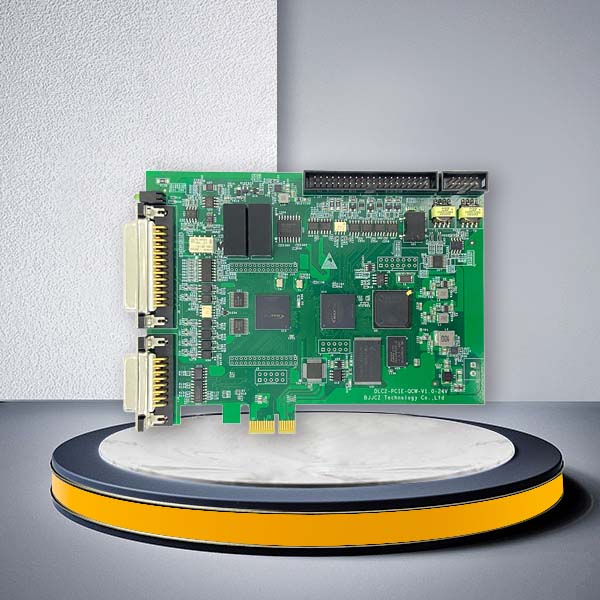
3D Laser Printing Controller for SLM, SLS, SLA…DLC-3DP 3D laser printing controller is developed for SLM, SLS and SLA. It can control laser galvo scanners with XY2-100 (16-bit), XY2-100 (18-bit), SL2-100 (20-bit) and most types of laser in the market like fiber, CO2, UV, YAG, QCW,SPI…
It combines galvo scanner control, laser-source control, extension-axis signals, digital I/O and analog sensor feedback within one control architecture. Together with compatible 3D printing software, it helps your engineering team convert STL model data into sliced layers and coordinate the laser, scanner, build platform and auxiliary equipment throughout the printing cycle.
Key capabilities:
- STL file import and slicing
- XY2-100 16-bit and 18-bit scanner support
- SL2-100 scanner support
- Fiber, CO2, UV, SPI and QCW laser compatibility
- 10 digital inputs
- 8 digital outputs
- Four extension-axis pulse/direction channels
- Four analog inputs and four analog outputs
- Real-time sensor data acquisition
- Liquid-level adjustment support
- Air-pump control
- Individual extension-axis parameter settings
- Standard software and development-library options
- Secondary software development support
What the Laser Additive Manufacturing Controller Does
A laser-based 3D printer does not only move a laser spot across a working field. It must repeat a coordinated build cycle across hundreds or thousands of layers.
Depending on the machine architecture, each layer may require:
- Reading or loading the next sliced layer
- Repositioning the build platform
- Supplying powder or resin
- Operating a recoater, pump or material-delivery mechanism
- Checking liquid level or other sensor signals
- Moving the galvo scanner through the selected hatch path
- Synchronizing laser output with scanner movement
- Returning completion and alarm signals
- Preparing the machine for the next layer
The controller provides the laser, galvo, axis and signal-control foundation for this cycle. Chamber temperature, gas circulation, oxygen monitoring, high-power safety and other process-specific systems may still require a PLC, dedicated safety controller or additional hardware.
How It Fits into an Additive-Manufacturing Machine
The DLC-3DP is a control component rather than a complete 3D printer.
A complete laser additive-manufacturing machine may also require:
- Fiber, CO2 or UV laser source
- 2D galvanometer scanner
- F-theta lens and beam-expansion optics
- Build platform and Z-axis
- Feed-bed or material-delivery axes
- Powder recoater or resin-handling mechanism
- Temperature-control system
- Inert-gas or ventilation system
- Liquid-level, pressure, temperature or position sensors
- Industrial computer
- Machine enclosure
- Safety interlocks
- Emergency-stop circuit
- PLC or additional motion controller
- Process-monitoring equipment
- Calibration tools
Application Configuration for SLA
SLA equipment uses a laser to cure selected regions of liquid photopolymer resin.
A typical SLA machine configuration may include:
- UV laser source
- Galvo scanner
- Resin tank
- Build platform
- Z-axis
- Liquid-level sensor
- Resin circulation or refill mechanism
- Air pump or auxiliary actuator
- Safety enclosure
The DLC-3DP’s sensor reading and liquid-position adjustment functions make it particularly relevant to machine architectures requiring feedback from the resin-handling system.
Application Configuration for SLS
SLS equipment uses laser energy to sinter selected areas of a powder layer.
The control architecture may need to coordinate:
- CO2 or another suitable laser
- Galvo scanner
- Build platform
- Powder feed platform
- Recoater or roller
- Chamber heating
- Material-delivery sequence
- Layer change
- Safety signals
The laser additive manufacturing controller can coordinate the laser, galvo, extension axes and I/O functions, while chamber-temperature control may remain under a separate PLC or temperature-control system.
Before ordering, confirm:
- Powder material
- Laser wavelength and power
- Build area
- Layer thickness
- Recoater type
- Number of motion axes
- Heating-control architecture
- Sensor types
- Required digital and analog signals
- Intended build duration
Galvo Scanner Selection
The controller supports compatible XY2-100 and SL2-100 scanner protocols, but protocol compatibility is only one part of scanner selection.
A faster scanner does not automatically produce a faster build. Total production time also depends on hatch strategy, laser power, material behavior, platform movement, recoating time and thermal constraints.
Standard Software or Customized Development
JCZ can provide compatible standard 3D printing software, development libraries and secondary-development support.
Choose Standard Software When:
- The machine follows a conventional SLA or SLS workflow.
- Standard STL import and slicing functions are sufficient.
- The axis and I/O sequence is relatively straightforward.
- You want to shorten machine-development time.
- Your operators require an existing user interface.
Choose a Development Library or SDK When:
- You need your own machine interface.
- The printer uses a proprietary layer workflow.
- You need custom parameter management.
- You need to connect the system to a database, MES or laboratory platform.
- The machine has specialized sensors or actuators.
- You need custom error handling and user permissions.
- You are developing a branded OEM machine platform.
Product Selection Comparison
| Your Requirement | Recommended Controller Direction |
|---|---|
| Standard flat laser marking or engraving | General laser marking controller |
| Sliced STL layer processing with laser and galvo synchronization | DLC-3DP additive-manufacturing configuration |
| SLA resin-level and platform control | DLC-3DP with compatible sensor and axis configuration |
| SLS powder-bed movement and recoater signals | DLC-3DP with external motion and machine-control components |
| Industrial SLM metal printing | Project-specific technical review before controller selection |
| High-axis-count mechanical processing | DLC controller combined with an additional motion controller |
| Large working field requiring stage and galvo coordination | Evaluate a large-area continuous-processing controller |
| Proprietary 3D printer software | Controller plus SDK or development library |
| Complete ready-to-run 3D printer | Purchase a complete machine, not only a controller |
Choose this laser additive manufacturing controller when the project requires STL slicing, galvo and laser coordination, extension-axis movement, sensor feedback and customizable machine logic.
Do not select it as a direct replacement based only on the DLC2 name. Confirm the full controller model, communication port, firmware, software package, laser interface and machine wiring.
Frequently Asked Questions
Is DLC-3DP a complete 3D printer?
No. It is a controller platform for coordinating laser, galvo, axes, I/O and sensor-related functions. A complete printer also requires a laser, scanner, optics, mechanical structure, material system, safety equipment and process-control components.
What is the difference between DLC-3DP and a standard marking controller?
A standard marking controller mainly executes two-dimensional marking jobs. DLC-3DP is configured around sliced layer processing, extension-axis movement, sensor feedback and auxiliary equipment used in additive-manufacturing workflows.
Does it support STL files?
Yes. The compatible software supports STL file import and slicing for layer-based processing.
Does it include slicing software?
A compatible standard software package is available. Confirm the exact delivery scope, software version, development library and licensing arrangement during quotation.
Which additive-manufacturing processes are supported?
The current specification table explicitly lists SLA and SLS. The product description also refers to SLM. SLM projects should be reviewed individually to confirm laser, scanner, safety, motion and software compatibility.
Which galvo protocols are supported?
The listed protocols include XY2-100 16-bit, XY2-100 18-bit and SL2-100.
Can it control the build platform?
It provides four pulse/direction extension-axis channels that may be configured for the build platform or other machine axes. Motor drivers and mechanical components are selected separately.
Can it control a powder recoater?
An extension axis or digital I/O may be assigned to a recoater mechanism, depending on the motor, driver and machine sequence. The complete movement and safety logic must be reviewed.
Does it support air-pump control?
Yes. Air-pump control is included in the listed functional scope, subject to correct I/O and electrical integration.
Can I develop my own 3D printer software?
Development libraries and secondary-development support are available. Submit the required user interface, file workflow, machine logic and communication requirements for evaluation.
Is the connection USB or Ethernet?
The current 3D printing controller specification lists USB 2.0. Because the page title also references DLC2-V3 and DLC2-ETH, confirm the exact supplied controller and communication port before ordering.
Can it be used for a metal SLM printer?
It can be evaluated for an SLM project, but suitability cannot be determined from the controller name alone. Provide the laser, galvo, powder-bed, chamber, gas, sensor, safety and software architecture for technical review.
Request a Laser Additive Manufacturing Controller Review
Send JCZ your machine architecture, selected printing process, laser model, scanhead protocol, build area, extension axes, sensor list and software requirements.
The engineering team can review the laser additive manufacturing controller, galvo scanner, laser interface, motion signals and 3D printing software as one coordinated machine-control solution.