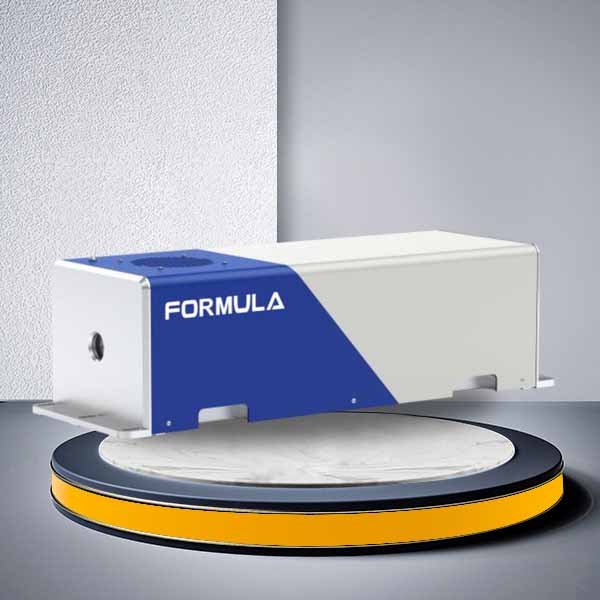
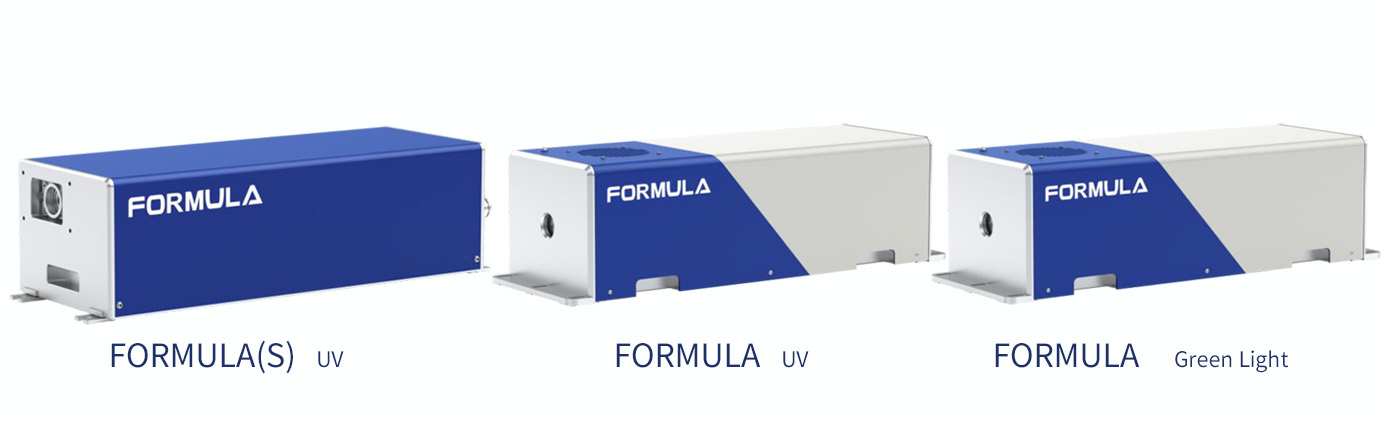
FORMULA (S) UV
| Parameter | 15W-30K | 20W-30K |
| Wavelength (nm) | 355 | |
| Average Power (Watts) | >15W @30kHz | >20W @30kHz |
| Pulse Energy (μJ) | >100 | >160 |
| Specified Frequency (kHz) | 30 | |
| Repetition Rate Range (kHz) | 10–300 | |
| Beam Quality (M²) | <1.2 | |
| Operating Temperature (°C) | 15–35 | |
| Average Power Consumption (Watts) | <110 | <130 |
| Power Supply Requirement (VDC/W) | 24V / 450W | |
| Weight (kg) | 7.2 | |
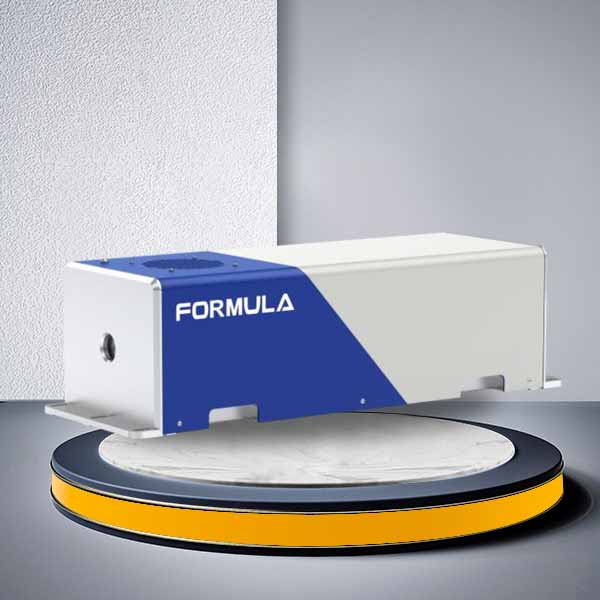
FORMULA UV
| Parameter | 15W-50K | 20W-60K | 25W-50K |
| Wavelength (nm) | 355 | ||
| Average Power (Watts) | >15W @50kHz | >20W @60kHz | >25W @50kHz |
| Pulse Energy (μJ) | >300 | >330 | >500 |
| Specified Frequency (kHz) | 50 | 60 | 50 |
| Repetition Rate Range (kHz) | 10–300 | ||
| Beam Quality (M²) | <1.2 | ||
| Operating Temperature (°C) | 5–40 | ||
| Average Power Consumption (Watts) | <260 | <310 | <350 |
| Power Supply Requirement (VDC/W) | 24V / 450W | 24V / 600W | |
| Weight (kg) | 20 | ||
FORMULA Green Light
| Parameter | 20W-50K | 35W-50K | 50W-50K |
| Wavelength (nm) | 532 | ||
| Average Power (Watts) | >20W @50kHz | >35W @50kHz | >50W @50kHz |
| Pulse Energy (μJ) | >400 | >700 | >1000 |
| Specified Frequency (kHz) | 50 | ||
| Repetition Rate Range (kHz) | 10–300 | ||
| Beam Quality (M²) | <1.2 | ||
| Operating Temperature (°C) | 15–35 | ||
| Average Power Consumption (Watts) | <260 | <310 | <350 |
| Power Supply Requirement (VDC/W) | 24V / 260W | 24V / 600W | |
| Weight (kg) | 20 | ||
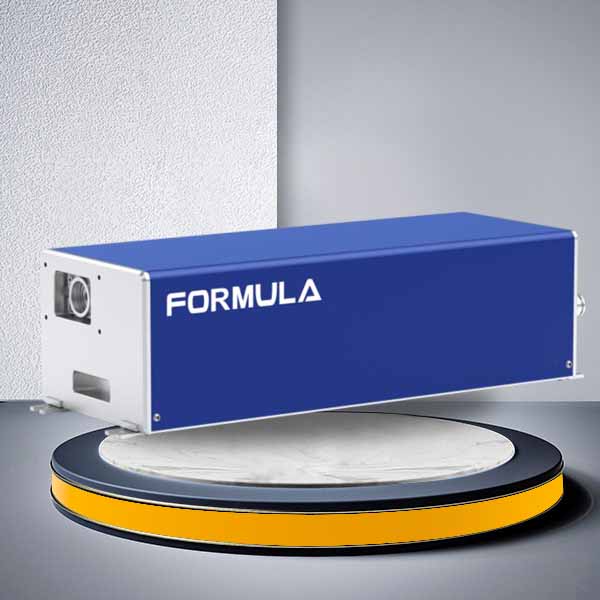
FORMULA series high-stability nanosecond Q-switched laser features compact design, superior beam quality, crystal auto-switching, smart power optimization, and real-time feedback. Ideal for UV and green laser applications including marking, engraving, and precision processing.
Product Pictures
Product Introduction
The FORMULA Series is an industrial UV and green nanosecond laser developed for laser equipment manufacturers and system integrators that need stable output, high pulse energy, precise beam delivery, and straightforward machine integration. The range includes 355 nm UV models from 15 W to 25 W and 532 nm green models from 20 W to 50 W, with repetition rates from 10 to 300 kHz and beam quality below M² 1.2.
Unlike a laser source selected only by wattage, the FORMULA Series is built around the factors that determine production performance: wavelength absorption, pulse energy, long-term power stability, beam quality, thermal management, control compatibility, and serviceability. Crystal auto-switching, intelligent power optimization, and real-time power monitoring help equipment builders maintain more consistent processing results during extended production.
Compact & Lightweight: Reduced size and light body, ideal for system integration.
Stable Power Performance: Integrated optical and electronic drive system for strong anti-interference capability.
Excellent Optical Performance: Industry-leading beam quality (M²<1.2), suitable for high-precision applications.
Crystal Auto-Switching: Laser crystal position automatically adjusts to maintain consistent output power.
Smart Power Optimization: Built-in intelligent algorithm ensures long-term power stability with variation <2%.
Real-Time Power Monitoring: GUI software displays live laser power for easy monitoring and control.
Why Choose This Industrial UV and Green Nanosecond Laser?
Stable Output for Production Equipment
Long-term output consistency directly affects mark contrast, cutting depth, feature dimensions, and reject rates. The integrated optical and electronic architecture is designed to reduce external interference, while intelligent power optimization maintains published power variation below 2%.
Automatic Crystal Position Management
Frequency-converted laser sources depend on nonlinear crystals for UV or green output. The automatic crystal-switching function adjusts the working crystal position to maintain output performance, reducing manual intervention and helping extend productive operating periods.
Real-Time Power Visibility
The operating interface displays live laser power, giving machine builders and operators a clearer view of source performance. This supports production monitoring, troubleshooting, preventive maintenance, and faster identification of abnormal power changes.
Beam Quality for Fine Processing
Beam quality below M² 1.2 supports tight focusing and controlled energy distribution. This is important when processing fine text, narrow cuts, small holes, thin coatings, electronic components, or parts with limited thermal tolerance.
Broad Power Coverage on One Platform
A common product family covering compact 15 W UV units through 50 W green units allows machine manufacturers to develop several equipment configurations with a more consistent sourcing and integration approach.
Three Distinct Product Directions
The FORMULA Series is not one laser offered at several wattages. Its models are divided into three practical purchasing directions.
Compact 355 nm UV Lasers
The 15W-30K and 20W-30K models are intended for equipment where machine size, installation weight, and electrical consumption are important.
| Model | Wavelength | Average Power | Frequency Range | Beam Quality | Weight |
|---|---|---|---|---|---|
| 15W-30K | 355 nm | >15 W at 30 kHz | 10–300 kHz | M² <1.2 | 7.2 kg |
| 20W-30K | 355 nm | >20 W at 30 kHz | 10–300 kHz | M² <1.2 | 7.2 kg |
These compact UV sources are suitable for smaller laser marking machines, automated workstations, and precision equipment that cannot allocate the installation space required by a larger laser unit.
Typical processes include fine marking on plastics, electronic components, cable materials, coated parts, glass, and packaging.
Higher-Pulse-Energy 355 nm UV Lasers
The 15W-50K, 20W-60K, and 25W-50K models are designed for buyers who need more pulse energy than the compact UV platform provides.
| Model | Average Power | Published Pulse Energy | Specified Frequency | Frequency Range |
| 15W-50K | >15 W | >300 μJ | 50 kHz | 10–300 kHz |
| 20W-60K | >20 W | >330 μJ | 60 kHz | 10–300 kHz |
| 25W-50K | >25 W | >500 μJ | 50 kHz | 10–300 kHz |
These models are better suited to processes where stronger energy delivery per pulse is required, such as material removal, fine drilling, scribing, coating stripping, and selected cutting applications.
A buyer should not automatically choose the highest wattage. The 20W and 25W versions should be evaluated according to required depth, feature size, processing speed, and acceptable thermal influence.
532 nm Green Nanosecond Lasers
The green models extend from 20 W to 50 W and provide pulse energy up to more than 1000 μJ at the specified operating frequency.
| Model | Average Power | Published Pulse Energy | Specified Frequency | Frequency Range |
| 20W-50K | >20 W | >400 μJ | 50 kHz | 10–300 kHz |
| 35W-50K | >35 W | >700 μJ | 50 kHz | 10–300 kHz |
| 50W-50K | >50 W | >1000 μJ | 50 kHz | 10–300 kHz |
The 532 nm models are intended for materials and process conditions where green light provides more useful absorption than conventional infrared output.
They can be evaluated for selected copper materials, ceramics, semiconductor components, coated surfaces, glass-related processing, and electronic manufacturing applications.
UV and Green Are Not Interchangeable
A buyer comparing an industrial UV and green nanosecond laser should begin with material response rather than machine power.
Select 355 nm UV when the process requires:
- A smaller focused spot
- Fine text or high-resolution graphics
- Controlled processing on heat-sensitive materials
- Strong absorption on many plastics and coatings
- Narrow cuts or small drilled features
- Reduced visible thermal damage around the processed area
Select 532 nm green when the process requires:
- Better absorption on selected metals and electronic materials
- Higher available average power
- Higher pulse energy for material removal
- Precision processing of ceramics or semiconductor-related parts
- A balance between fine processing and production speed
The same material category can react differently depending on additives, coating thickness, surface finish, and internal structure. A black plastic, transparent polymer, coated glass, and copper laminate cannot be selected only from a general material name.
The final wavelength and model should therefore be confirmed using the actual workpiece.

Application Cases
Application Areas
Electronics and 3C Manufacturing
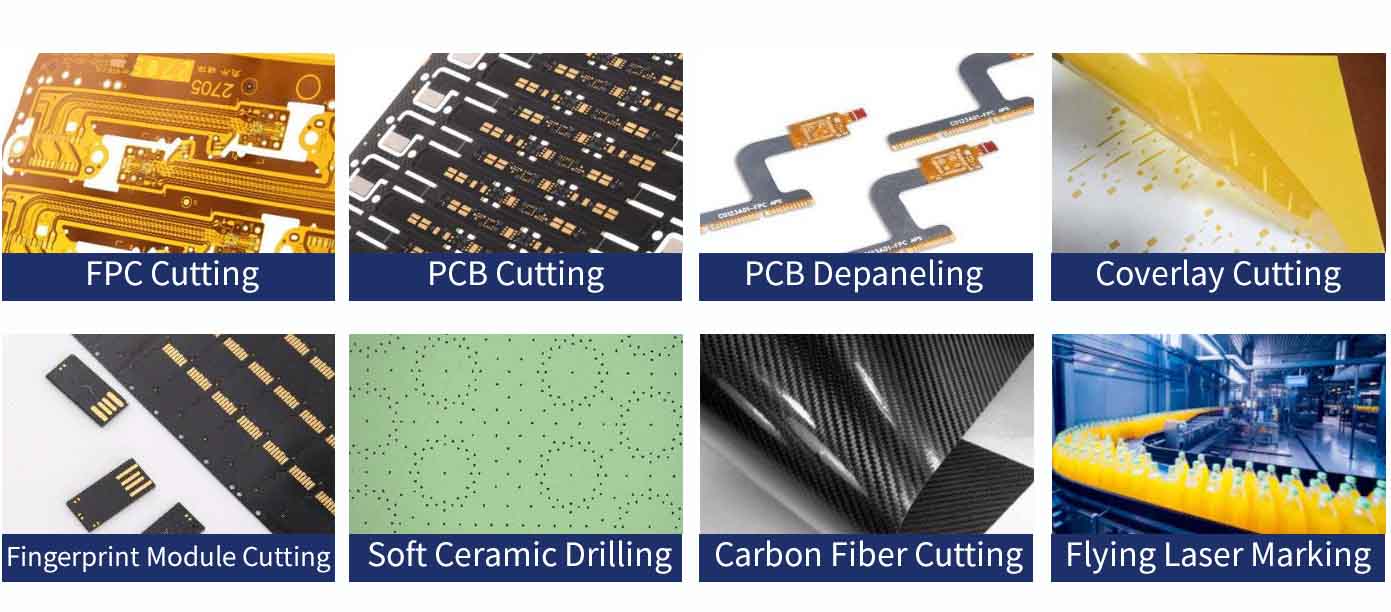
The Q-switched nanosecond laser source can be evaluated for PCB marking, cable marking, charger identification, mobile-device component marking, coating removal, fine cutting, and other traceability or precision-processing tasks.
Packaging and Pharmaceutical Identification
UV output can create clear marks on selected plastic, paper, glass, pharmaceutical, and coated packaging materials without inks or consumables. The correct parameters must be confirmed for contrast, permanence, and line speed.
Medical and Dental Manufacturing
The high-stability pulsed laser can support precision marking and selected material-processing steps for medical and dental components where fine features and process consistency are important. Validation remains the responsibility of the equipment manufacturer and end user.
Additive Manufacturing and Precision Fabrication
High-power UV or green output can be considered for selected 3D-printing, microfabrication, thin-film, ceramic, glass, and aerospace-component processes. The laser source should be tested together with the intended scanner, optics, motion platform, and process gas arrangement.
Integration Considerations for OEM Equipment
The compact industrial UV and green nanosecond laser is designed for installation in industrial marking and precision-processing equipment, but buyers should confirm the complete interface before ordering.
Review the following items with the technical team:
- Selected wavelength and model
- Laser-head and power-unit dimensions
- Mounting orientation and available machine space
- Cooling configuration
- 24 VDC supply capacity
- Average and peak electrical load
- Scanner and control-card compatibility
- Trigger mode and production-line synchronization
- Communication interface and monitoring requirements
- Beam height, beam diameter, divergence, and polarization
- F-theta lens or optical-path requirements
- Ambient temperature and enclosure conditions
- Dust, vibration, and humidity exposure
- Laser safety interlocks and enclosure requirements
- Required cables, connectors, and accessories
Providing these details before purchase reduces redesign work and shortens equipment commissioning.
Frequently Asked Questions
Is FORMULA a complete laser marking machine?
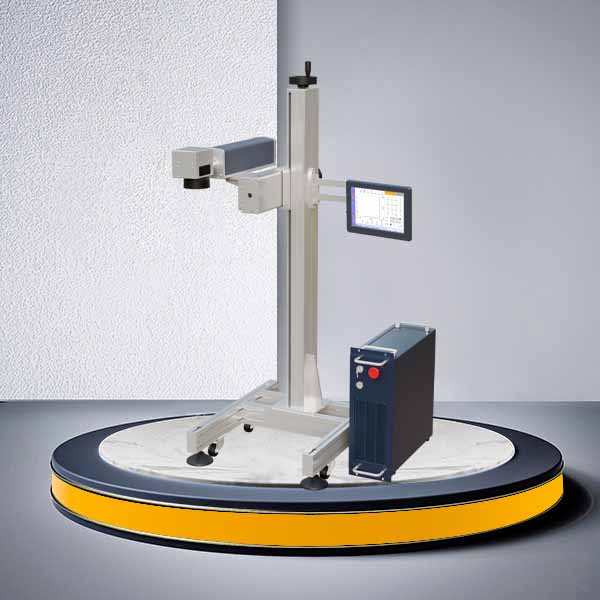
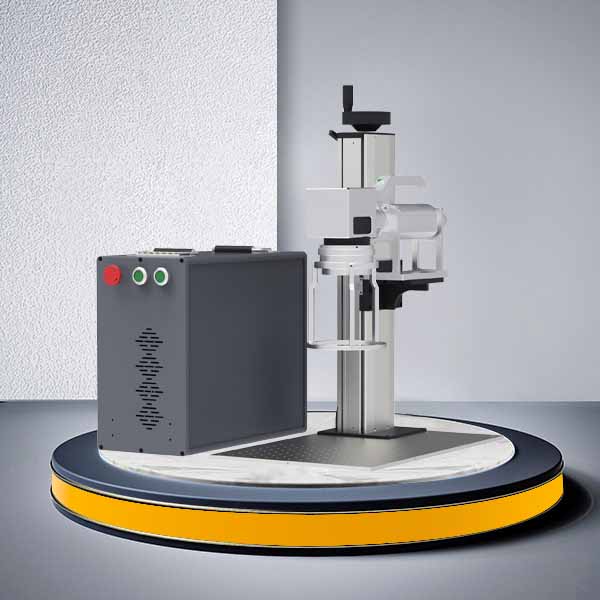
No. It is an industrial laser source intended for integration with a controller, galvo scanner, lens, safety enclosure, motion system, and other machine components.
Does higher average power always produce a better result?
No. Wavelength absorption, pulse energy, beam quality, spot size, repetition rate, scan strategy, and material thickness can be more important than average power alone.
How does crystal auto-switching help the user?
It changes the active crystal working position to help maintain stable frequency-converted output and reduce the need for manual optical adjustment.
Can laser power be monitored during operation?
Yes. The published product features include real-time power display through the operating interface.
Can the laser process transparent materials?
UV or green wavelengths can be suitable for selected transparent and coated materials, but the result depends on material composition, thickness, focus position, and the required type of modification. Sample testing is necessary.
Does real-time power monitoring replace process inspection?
No. It provides source-condition information, but the equipment manufacturer should still inspect mark contrast, dimensions, cut quality, or other finished-part criteria.
Can the source replace an existing UV or green laser?
Replacement is possible only after checking mechanical dimensions, beam position, power supply, cooling, control signals, scanner compatibility, lens wavelength, and process parameters.
Request a Quote for the Industrial UV and Green Nanosecond Laser
Send your material, process, target speed, required quality, and machine-integration details. The technical team will help identify a suitable 355 nm UV or 532 nm green configuration and prepare the relevant specification, testing direction, and quotation.