Introduction
As industrial laser technology continues to evolve, more manufacturers are comparing fiber laser vs UV laser systems when selecting equipment for precision marking, engraving, cutting, and micro-processing applications.
Both fiber laser and UV laser technologies are widely used in modern manufacturing, but they serve different materials and production requirements. Choosing the right laser source can directly affect product quality, production efficiency, maintenance cost, and long-term manufacturing stability.
In this guide, we will compare fiber laser vs UV laser technologies in detail, including working principles, applications, advantages, limitations, and how to choose the best laser solution for your business.
What Is a Fiber Laser?
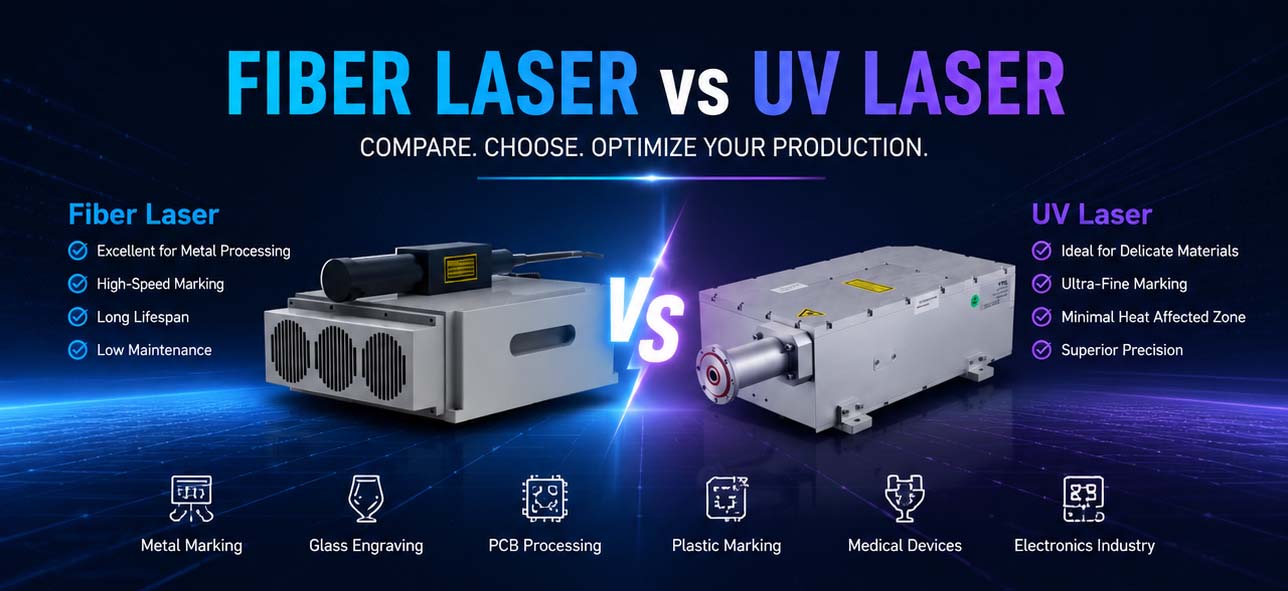
A fiber laser is a solid-state laser that uses optical fiber doped with rare-earth elements as the gain medium. Fiber laser systems usually operate at a wavelength of 1064nm and are widely used for metal processing applications.
Fiber laser technology is known for:
- High electro-optical efficiency
- Long service life
- Low maintenance
- High-speed marking
- Excellent metal processing ability
Today, fiber laser systems are commonly used in:
- Metal marking
- Stainless steel engraving
- Aluminum processing
- Laser cleaning
- Laser welding
- Deep engraving
- Industrial coding
What Is a UV Laser?
A uv laser typically operates at a wavelength of 355nm and belongs to the ultraviolet laser category.
Unlike traditional thermal processing methods, UV laser technology is often called “cold laser processing” because it produces a very small heat-affected zone.
This makes uv laser systems ideal for delicate materials and ultra-precision applications.
UV laser systems are widely used for:
- Glass marking
- PCB processing
- Plastic marking
- Semiconductor applications
- Medical device marking
- Flexible circuit processing
- Precision electronics manufacturing
Fiber Laser vs UV Laser: Core Differences
Wavelength Difference
The biggest difference between fiber laser vs UV laser is wavelength.
- Fiber laser wavelength: 1064nm
- UV laser wavelength: 355nm
The shorter wavelength of uv laser systems allows better absorption by non-metal materials.
As a result, UV laser processing creates finer marking quality with lower thermal damage.
Heat-Affected Zone Comparison
Fiber Laser
Fiber laser systems generate more thermal impact during processing. While this is excellent for metal engraving and deep marking, it may damage heat-sensitive materials.
UV Laser
UV laser systems create extremely small heat-affected zones, making them suitable for fragile materials such as:
- Glass
- Plastic
- Ceramic
- Sapphire
- Silicon wafers
For precision micro-processing, uv laser technology usually performs better.
Material Compatibility
Fiber Laser Best Materials
Fiber laser systems work best on:
- Stainless steel
- Aluminum
- Brass
- Copper
- Iron
- Gold
- Silver
- Hard plastics
Fiber laser technology is especially popular in industrial metal processing industries.
UV Laser Best Materials
UV laser systems are ideal for:
- Glass
- Transparent plastic
- Acrylic
- PCB boards
- Silicone
- Ceramic
- Medical packaging
- Electronic components
UV laser processing is preferred for delicate and high-precision materials.
Marking Quality Comparison
Fiber Laser Marking
Fiber laser systems produce:
- Deep engraving
- Fast marking speed
- Strong contrast on metals
- Durable industrial marks
However, some plastics may burn or discolor during processing.
UV Laser Marking
UV laser systems offer:
- Ultra-fine marking
- Smooth edges
- Minimal burning
- High-resolution QR codes
- Excellent precision on small components
For electronics and medical industries, UV laser marking often delivers superior results.
Fiber Laser vs UV Laser for Plastic Marking
Plastic marking is one of the biggest differences between fiber laser vs UV laser applications.
Fiber Laser on Plastic
Fiber laser systems can mark certain plastics, but may cause:
- Burning
- Yellowing
- Surface melting
UV Laser on Plastic
UV laser systems create cleaner and more precise plastic marks with minimal thermal damage.
This is especially important for:
- Medical devices
- Cosmetic packaging
- Electronic connectors
- Consumer electronics
For high-end plastic marking, uv laser systems are usually the better option.
Fiber Laser vs UV Laser for Glass Marking
Glass processing is another major comparison area.
Fiber Laser for Glass
Standard fiber laser systems are generally not ideal for transparent glass because glass absorbs 1064nm wavelength poorly.
Fiber laser technology is mainly suitable for coated or painted glass surfaces.
UV Laser for Glass
UV laser systems are considered one of the best solutions for glass marking because the shorter wavelength improves absorption and reduces cracking risks.
Typical UV laser glass applications include:
- Smartphone cover glass
- Bottle engraving
- QR code marking
- Medical glass tube coding
For glass processing, uv laser systems clearly outperform fiber laser technology.
Fiber Laser vs UV Laser for PCB Processing
PCB and semiconductor industries require ultra-high precision.
Why UV Laser Dominates PCB Applications
UV laser systems provide:
- Cleaner cutting edges
- Reduced carbonization
- Better micro-hole drilling
- High precision circuit processing
Fiber laser systems are generally not suitable for delicate PCB micro-processing applications.
Speed Comparison
Fiber Laser Speed
Fiber laser systems are usually faster for industrial metal marking and mass production.
Advantages include:
- High-speed galvanometer compatibility
- Efficient deep engraving
- Large-scale production capability
UV Laser Speed
UV laser systems prioritize precision over speed.
Although slightly slower in some applications, the processing quality is often much better for sensitive materials.
Cost Comparison
Fiber Laser Cost Advantages
Fiber laser systems usually offer:
- Lower operating costs
- Longer lifespan
- Lower maintenance
- Better ROI for metal processing
This makes fiber laser technology highly cost-effective for industrial manufacturing.
UV Laser Cost Considerations
UV laser systems are generally more expensive because of:
- Complex optical systems
- Precision components
- Higher technical requirements
However, for precision electronics and medical manufacturing, the improved processing quality often justifies the investment.
Industries Using Fiber Laser Systems
Fiber laser technology is widely used in:
| Industry | Application |
|---|---|
| Automotive | Metal part marking |
| Aerospace | Deep engraving |
| Hardware | Tool engraving |
| Jewelry | Precious metal marking |
| Industrial Manufacturing | Serial number coding |
| Laser Cleaning | Rust removal |
| Welding | Metal welding |
Industries Using UV Laser Systems
UV laser technology is widely used in:
| Industry | Application |
|---|---|
| Consumer Electronics | PCB marking |
| Medical Devices | Precision coding |
| Semiconductor | Wafer processing |
| Packaging | Plastic bottle marking |
| Glass Manufacturing | Glass engraving |
| Flexible Electronics | FPC processing |
| Precision Manufacturing | Micro-marking |
How to Choose Between Fiber Laser vs UV Laser
Choose Fiber Laser If You Need:
- Metal engraving
- Deep marking
- Fast industrial production
- Laser cleaning
- Welding applications
- Lower operating costs
Choose UV Laser If You Need:
- Glass marking
- Plastic processing
- PCB cutting
- High-precision micro-marking
- Medical device manufacturing
- Minimal thermal damage
Future Trends in Industrial Laser Processing
The future of industrial laser technology is moving toward:
- Ultrafast laser systems
- AI vision integration
- Automated production lines
- Precision micro-processing
- Smart manufacturing
- Green manufacturing solutions
Both fiber laser and UV laser technologies will continue to grow rapidly across global manufacturing industries.
Conclusion
When comparing fiber laser vs UV laser systems, there is no single “best” solution for every application.
The right laser source depends on:
- Material type
- Production requirements
- Precision level
- Processing speed
- Budget
In general:
- Fiber laser systems are best for metal processing and industrial efficiency.
- UV laser systems are ideal for delicate materials and precision applications.
Choosing the correct laser technology can significantly improve production quality, efficiency, and long-term manufacturing competitiveness.
Why Choose Our Laser Solutions
We provide professional industrial laser solutions for global manufacturers, including:
- Fiber laser source
- UV laser source
- Picosecond laser systems
- Laser control systems
- Galvo scanning solutions
- Customized automation integration
Our team supports customers with:
- Free sample testing
- OEM/ODM services
- Application engineering support
- Global technical assistance
- Production line integration
If you are looking for the right solution between fiber laser vs UV laser technologies, contact us today for professional consultation and customized laser solutions.
OFFICIAL DRIVER UPDATE NOTICE

Top Factors That Affect Marking Quality in Handheld Fiber Laser Systems
Meet JCZ at Laser World of Photonics India 2026 in Bengaluru
Laser Marking Fabric with Portable Laser Engraver: Advanced UV Laser Marking Solutions for Modern Manufacturing
Laser Machine for Marking: The Ultimate Guide to Portable Fiber Engravers & MOPA Color Laser Marking
Laser Cleaning Machine for Wood: The Ultimate Guide to Safe, Precise & Eco-Friendly Wood Surface Cleaning